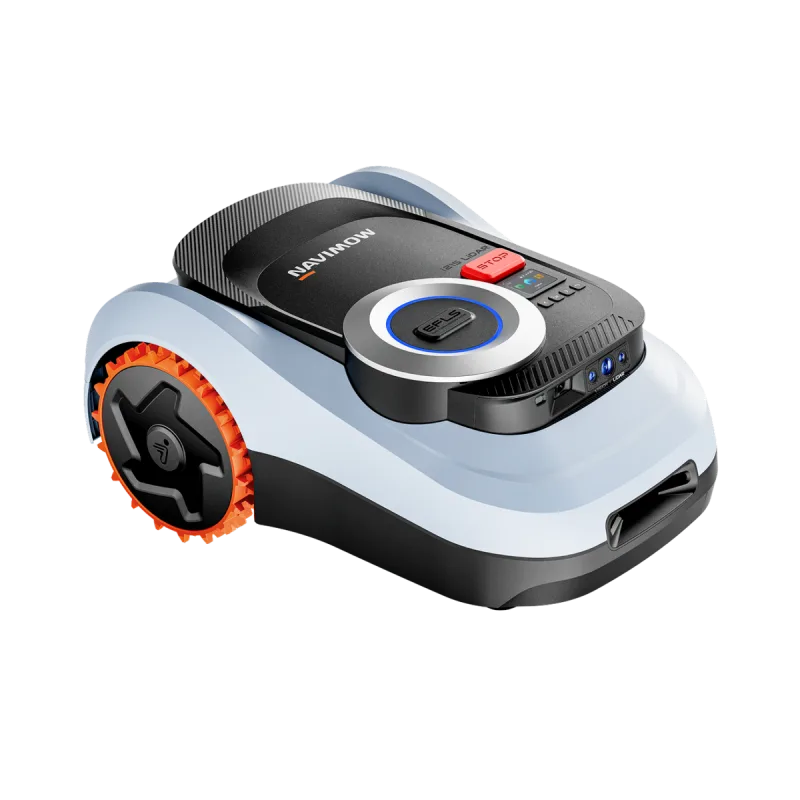
LiDAR Robot Mowers Explained
A laser scanner that maps the garden in real time — independent of satellites, and unbothered by the tree cover that stops RTK.
LiDAR — Light Detection and Ranging — is the same family of technology used by self-driving cars and by archaeologists mapping terrain from aircraft. On a robot mower it does something quite different from satellite positioning.
How it works
A laser emitter sends out rapid pulses of invisible light and sweeps them across the scene. Older units spin a mirror or the whole sensor; solid-state units, now common on garden machines, steer the beam electronically and have no moving parts to wear out. When a pulse strikes something — a fence, a tree trunk, a wall, a garden bench — part of it reflects back. The sensor measures the time taken and multiplies by the speed of light to get the distance.
Do that thousands of times a second in every direction and you have a live map of everything around the mower, accurate to centimetres.
The important difference
RTK tells the mower where it is in the world. LiDAR tells the mower what is around it.
That distinction explains everything about how they behave. LiDAR never looks up, so it does not care about satellites, canopy, buildings or weather in the sky. It navigates by the garden itself.
Where LiDAR is strong
Under trees. The headline advantage. A canopy that would leave an RTK mower waiting for signal has no effect on a laser scanner looking sideways.
Around obstacles. A system already mapping its surroundings can identify and drive around the watering can you left out, rather than bumping into it.
In enclosed gardens. Walls, fences and hedges are exactly the features LiDAR navigates by. The enclosed, built-up garden that defeats satellite positioning is the one LiDAR likes best.
In darkness. The laser provides its own light, so night mowing is unaffected.
Where LiDAR struggles
Featureless open space. A very large, flat, empty lawn with distant boundaries gives the scanner little to fix on. This is precisely the situation RTK handles best.
Heavy weather. Rain, fog and snow scatter laser light. Most mowers avoid mowing in heavy rain anyway, but reliability does fall in poor conditions.
Tall grass. Grass standing high enough to enter the scanner's plane can be read as an obstacle, causing unnecessary avoidance.
Cost. LiDAR modules are relatively expensive and appear mostly on premium models.
Dirt. The optical window needs occasional cleaning. Mud or a spider's web across it degrades performance in ways that can be puzzling until you look.
LiDAR combined with satellite positioning
The two are close to perfect complements. Satellite positioning gives absolute position in open space; LiDAR gives local awareness where the sky is blocked.
A mower using both can work across an open lawn efficiently and continue under trees without pause. For a mixed garden this combination is the most robust arrangement currently available.
Who LiDAR suits
Consider a LiDAR model if your garden has mature trees, high walls or fences, plenty of obstacles and furniture, or if the plot is enclosed and built up.
Be more cautious if the garden is a single very large open field with distant boundaries and few landmarks — there, satellite positioning has the advantage.