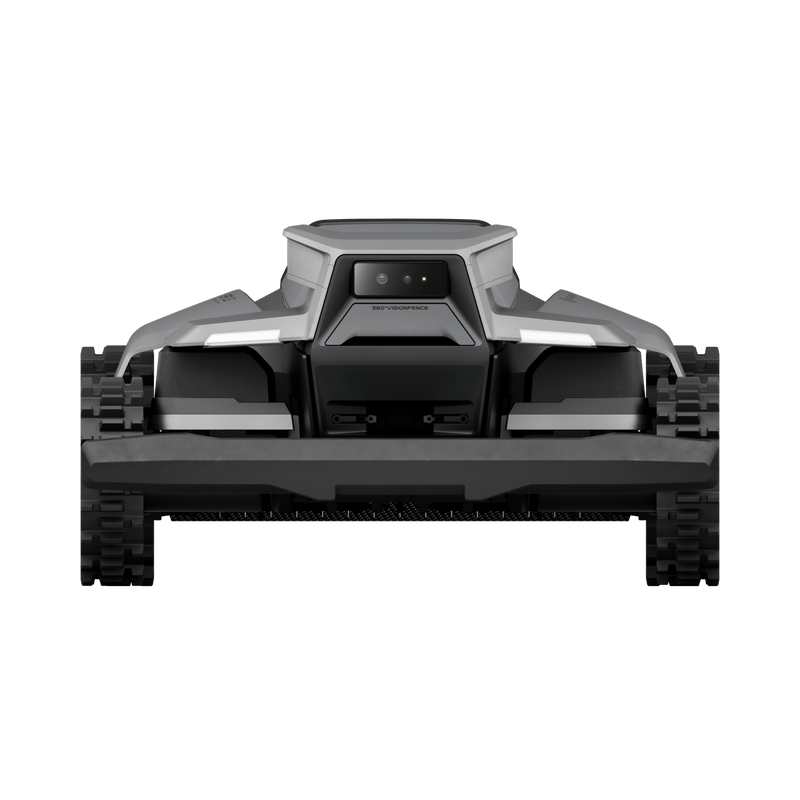
RTK Robot Mowers Explained
Satellite positioning corrected to a few centimetres — by a network service, or by a base station on your property.
RTK — Real-Time Kinematic positioning — is the technology that made wire-free robot mowing practical. It is worth understanding both what it does and where it stops working.
The problem it solves
A plain satellite receiver is accurate to a few metres. That is fine for driving directions and useless for a mower, which needs to know whether it is on the lawn or in the flower bed.
Most of that error is not random. It comes from the signal being delayed as it passes through the atmosphere, and the delay is almost identical for two receivers standing close together.
How RTK exploits that
Install a second receiver at a fixed point on your property and tell it exactly where it is. It compares its known position with the position the satellites currently suggest, and the difference is the current error.
It broadcasts that correction to the mower, which subtracts it. Both receivers are experiencing almost the same atmospheric delay, so the correction is almost exactly right.
The result is positioning accurate to a few centimetres, updated continuously.
What that accuracy buys you
- No boundary wire. Boundaries become lines on a map.
- Systematic mowing patterns. Knowing its position lets the mower cut in parallel lines, covering the lawn faster with less repetition.
- Precise no-go zones. Drawing an exclusion around a flower bed in an app actually works.
- Instant layout changes. Redraw the boundary rather than digging up a cable.
Where the correction signal comes from
RTK needs a correction stream, and there are two quite different ways of getting one. Which one a model uses changes the installation completely, so check before you buy.
A local reference antenna. A fixed unit on your own property that receives satellites and measures the current error. It needs a clear, unobstructed view of the sky — typically a roof, the top of a wall, or a post in an open part of the garden. It also needs power, and it needs to stay put: move it and the whole coordinate system shifts. For one of these, identify the actual spot where it will live before you buy. If there is nowhere with clear sky, that model is the wrong choice for your garden.
Network RTK. The correction arrives over a mobile data connection from a network of permanent reference stations, so nothing is mounted on your property at all. What matters instead is mobile coverage at the garden itself.
Both kinds appear in this database: the Segway Navimow range uses Network RTK with nothing to mount, while the Mammotion Luba 2 AWD series ships with its own local RTK reference station that needs a clear-sky mounting spot. Check which kind any model you compare uses — the installation differs completely.
Where RTK fails
Anything between the mower and the satellites degrades the signal:
- Mature trees, especially in full leaf and especially conifers
- Tall buildings and boundary walls
- Narrow passages between structures
- Dense hedging along a boundary
There is also multipath error: signals bouncing off a wall arrive late, and the receiver may compute a confident but wrong position. This is why a mower can occasionally behave oddly beside a building even when it reports good reception.
When correction is lost, a typical RTK mower slows, pauses, or falls back to a less accurate mode until reception returns.
Who RTK suits
RTK is an excellent fit for an open lawn with clear sky, a garden whose layout you expect to change, or a large area where efficient parallel mowing saves real time.
It is a poor fit for a heavily wooded garden, a narrow plot hemmed in by tall buildings, or — where the model relies on a local reference antenna — a property with nowhere sensible to mount one.
For a mixed garden, look for a model that pairs RTK with on-board sensing, so it has something to fall back on where the sky disappears.